Everything you need to know about India
India is unlike anywhere else in the world. The culture, the customs, the norms,
The food and views are different from anything you are familiar with.
Here on this page you will find everything you need to know before traveling to India.
What are you looking for?
General Information:-
India is the seventh largest country in the world, and the most populous in the world. It is divided into 28 states (which are themselves divided into provinces), each with its own unique dialects and traditions.
To enter India, a visa is required. The visa application is filled out electronically and after a few days you receive the electronic visa by email, which you show when you land at the airport.
All the details about the different types of visas, how and where to fill them out, and answers to other questions can be found here – Visa to India.
The local currency is Indian Rupee (1 shekel = approximately 22 rupees).
You can withdraw up to 10,000 rupees per withdrawal at ATMs in India (approximately 450 NIS). The blue SBI ATM is free of local fees.
It is recommended to get an AIRTEL SIM. To get a SIM, you must come with your passport.
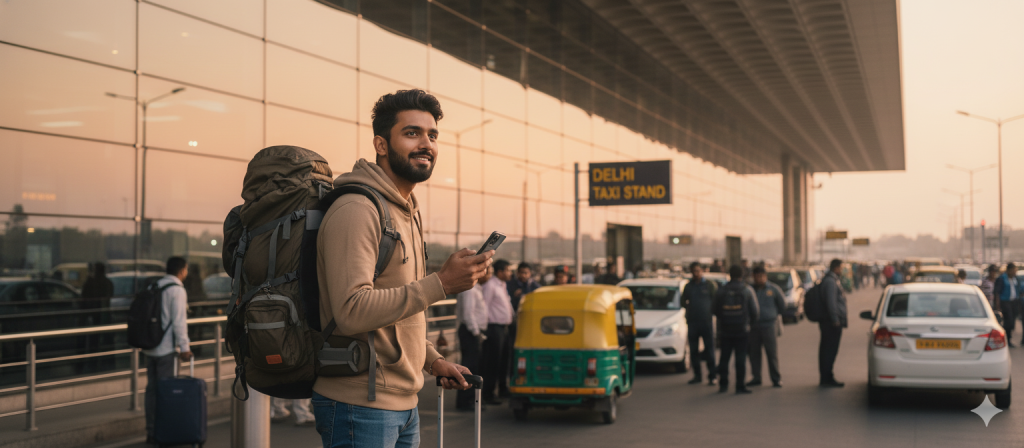
If you are landing in Delhi for the first time, and general things you should know when arriving in India
- There is no WiFi at the airport. There is an information desk in the baggage claim hall through which you can only obtain a username and password and connect to the airport's Internet.
When leaving the airport: Lots and lots of people will jump right at you, trying to wear you down and not wanting to leave until you agree to come with them in a taxi. Be assertive if necessary and even firm and don't agree to come with them! This usually ends up being a scam. If you want to ask someone to call you, make sure it's the right number. It's a good idea to pre-enter the number of a hotel or Chabad house into your phone.
Therefore, it is recommended to arrange with a taxi driver to wait for you in advance, of course this is not the most affordable option, so for those who want to save money, how can you still travel properly from the airport? It is not as complicated as it sounds. There are many options of official taxi stands at the airport or in the metro.
- If you have not arranged with a taxi driver and you wish to take a taxi from the airport, there are organized taxi counters at the airport that you pay in advance – PRE-PAID TAXI. Look for them and make sure they are the right ones.
- There are counters for the well-known and useful transportation apps in India – UBER, OLA, look for them on signs, ask people and this is the most affordable option. This requires internet access, which can be activated for you at the counters. It is recommended to download the apps in advance.
- Another option for getting from the airport to the city is the metro that leaves right from the airport.
- The Main Bazaar is never closed! There is no such thing.
- Taxi service in Main Bazaar You can see large electric tuk-tuks roaming around Main Bazaar. These are service taxis that travel along Main Bazaar and reach the metro station at the end. The fare is 10 rupees, whether there are people or not. Usually when they see you are a tourist they will ask you for more, but tell them you know the price is 10 rupees.
- ATMs and currency exchange offices in the airport: There are several different ATMs at the airport. There is the blue SBI without the commission right at the exit from the airport. It often runs out of money. Exchange offices at the airport will have much worse rates than the rates that can be found in the city. If you need to exchange money at the airport, it is recommended to exchange only a small amount that will last until you reach your hotel and then inquire about recommended exchange offices (for example, Avi the agent in Main Bazaar). You get a better rate for large bills.
- Local SIM in the field: You can buy a SIM at the airport, it will be slightly more expensive than buying one in the city itself (a difference of 5-10 NIS) and you will probably receive the SIM when it is not yet activated and you will have to call to activate it yourself using the instructions you will receive. On the other hand, if you buy a SIM in the city, you will have to wait a little, but you will receive the SIM activated (it takes about 45 minutes, you need a passport and a visa).
- More information about Delhi can be found here.
- For any questions, you can contact us on WhatsApp.
Prepare for culture shock
India is unlike any other place in the world. The first thing you will discover during your trip to India is that almost everything you experience – from the most amazing adventures to the most boring daily routines – is a once-in-a-lifetime experience that you will not have anywhere else. Indian culture is so different and unique that visiting it often feels like a journey to another world.
The worldviews of the locals, social norms, the treatment of women, child labor, poverty, the many animals roaming the streets, and the way people communicate and behave are just some of the things that will leave you speechless. There is no encounter with India that does not leave you speechless. It is better to simply accept this fact in advance, keep an open mind, leave your expectations at home and not try to change the behavior of the locals. It takes some time to get used to and accept things, and when that happens, you fall in love and devote yourself to India and you cannot break away from it.
Set a general itinerary in advance
India is not just a place to travel, it is a place that just happens to you. It is likely that your travel plans will change more than once depending on the experiences you have. However, it is a good idea to have at least a general plan for your trip. India is huge and it is worth recognizing in advance the fact that there is no chance of exhausting even a small part of it. In addition, many of the areas in India are very intense and overwhelming and sometimes we will need rest and recovery in quieter and calmer places. Therefore, it is better not to try to devour it all in one go. It is better to take your time and visit fewer destinations in much more depth.
Food in India
Like India's spectacular landscapes, Indian cuisine is colorful, rich, diverse, and varies from place to place. It is characterized by dishes rich in spices and sauces, consisting mainly of legumes such as lentils, beans, and chickpeas, vegetable stews cooked in thick, delicious sauces, and all served with piles of white rice or one of the types of breads - naan, chapati, or roti.
Indian food is special and very delicious, but the flavors are very different from the flavors we are used to in Israel. This must be taken into account and remembered that local food is an integral part of the experience and the trip, but that in tourist places you can always find familiar Western food.
In addition, the level of hygiene in India is particularly low compared to the Western world, and one should consider where to eat. It is recommended to eat in places where there are a lot of people and where you can see that the turnover is high. It is especially worth considering where to eat meat and uncooked food such as vegetables.
Restaurants in India on the hummus trail and off the hummus trail:
We have compiled restaurants for you according to all regions in India. On site You can easily find the specific area where you are looking to eat or go in to see the options it offers. Each destination has a division of restaurants in general, and more specific categories such as vegetarian and even vegan restaurants, Indian food, Western food and more, to ensure a convenient and easy search and so that you can find the place that best suits you.
Restaurants in India for hummus: When we talk about the Hummus Trail, we are talking about destinations in India that are very familiar to Israelis and that many Israelis visit. As a result, a very widespread phenomenon has developed: Restaurants in India Serving Western food that is tailored to tourists in general and Israelis in particular. This means that in most touristy places you can find a wide variety of food that we are used to seeing in Israel, such as shakshuka, muesli, hummus, tahini, pasta, toast, omelets, and more. Of course, the prices of Western food will be slightly more expensive than the local food that the local population eats. (These are still extremely low prices compared to prices in Israel).
Additionally, there are places in India that allow food to be delivered from restaurants to your room or wherever you want. This service can also be found mainly in large cities and tourist areas.
Restaurants in India off the hummus trail: When we talk about restaurants off the hummus trail, we are of course talking about local Indian cuisine. India is huge and diverse, and so is its cuisine, which varies slightly from region to region. But no matter where you go, you will always encounter rich and colorful dishes, full of unique aromas and spices.
You can also search Restaurants off the hummus trail on site Depending on location and personal preferences.
Indian cuisine is primarily vegetarian, and includes mostly white rice and dishes with legumes or cooked vegetables. Common ingredients in Indian cuisine are lentils, beans, potatoes, rice grains, and paneer cheese. Those interested in finding meat dishes will be able to find dishes mainly made with chicken or lamb. Cow meat is not eaten in India.
Maintain modest dress.
Although India can be very hot, it is not recommended to dress in revealing clothing. It is a very conservative society and such clothing can attract a lot of negative attention. Whether from religious people who will be angered by this clothing or from annoying locals who are very easy to meet in India. Indians are known for having different boundaries regarding physical and mental personal space than those accepted in the Western world, so you should consider how you want to dress and how you want to be treated by the locals.
In addition, India has many, many temples and religious buildings, where one must dress modestly to respect ancient tradition.
It is always recommended to carry a scarf or shawl just in case.
Stores in India
You can't experience and travel in India without shopping. India is known worldwide for its colorful and diverse goods at extremely cheap prices that can't be found almost anywhere else in the world. Shopping in India ranges from special and beautiful fabrics, clothes of all kinds for all needs, incense and spices, shoes, bags, accessories, leather products, fine cosmetics, special photos and paintings, and even home products and furniture at extremely affordable prices.
The stores are colorful and inviting, and the shopping experience can be enjoyable in itself by wandering through the various stores on the main streets or in the small, quiet alleys. But there are also places where you can order products online and have them delivered to your door.
Another very well-known site for this is Amazon India – the most successful Indian version of the well-known site. In large cities and tourist locations, you can use Amazon to order various products that will arrive very quickly (usually within 2-5 days) and right to your door.
Learn to bargain
Bargaining is a natural part of the way people shop in India. For Israelis, this art is not foreign at all, and it is worth knowing that Indians do not see trying to lower a price as disrespectful behavior, but rather as friendly negotiation. In most cases, sellers will offer high prices, precisely because they expect bargaining. The price is always negotiable. It is important to know that you should maintain a respectful conversation and not start shouting and getting angry. The seller has the right not to go below a certain price, just as you have the right not to buy.
Be more flexible with your personal space
As Westerners, we are used to privacy being sacred and most people, especially foreigners, giving us personal space. In a country of over 1.2 billion people, personal space has a different concept than we are used to. People push each other into each other's space physically and blatantly, stare and stare, and can strike up a conversation with complete strangers. Often when traveling on local buses or standing in lines, you will encounter people who are less likely to push and shove you and may even lay hands on you. There is no point in taking it too hard and getting angry, it is better to accept the situation and if it is really uncomfortable, you can move on. It is simply part of the way this unique culture works. Once we understand this, it will be much easier for us to get along in India.
Set the clock to India time.
Plans in India should always be taken with a grain of salt. Buses, trains, and even taxis don't necessarily leave when scheduled, Indian friends may simply not show up for scheduled meetings, and if you've ordered a meal at a restaurant, it's worth opening a book and taking your time. The perception of time when traveling in India is going to change. It's not for nothing that the phrase "India time" has been coined.
This is a great opportunity to learn to let go, enter the Shanti atmosphere, and along the way, develop patience skills you didn't know you had.
Transportation in India
India is such a different, unique and diverse country, so it really shouldn't surprise us that the experience of using transportation in India is also extraordinary. In what other country can we travel hundreds of kilometers for days on an old train, travel for hours through mountains on local buses, get from place to place on broken roads in rickshaws or on an innovative and modern metro, or simply fly easily and efficiently from destination to destination.
India has everything when it comes to transportation solutions.
You can find out all the information about mobility and transportation in the most convenient and efficient way on our page on Transportation in India.
Water and hygiene in India
The level of hygiene in the East in general, and in India in particular, is very low compared to what we know in the Western world. Of course, you shouldn't drink tap water, so what do you do? You only drink water from bottles that have been hermetically sealed beforehand, or you stock up on purification tablets or filter bottles.
Apart from the water, the lack of hygiene, sterility and cleanliness in India is widespread everywhere and you will encounter it all the time. You will not find toilet paper in the bathrooms and often you will not find a toilet at all. There is nothing to get excited about, like all the different phenomena in India, you should just get used to it and adapt yourself and maybe you will even manage to connect with some of the things and develop new habits. It is recommended to carry around wipes, toilet paper, hand sanitizer, and anything that will make you feel comfortable. Especially when traveling.
The "What's Happening in India" team is here to guide you and help you at every point of your journey. From hotel and restaurant recommendations to advice on any matter, we invite you to search our website that can answer all your questions, or contact us and our team will get back to you with all the information.