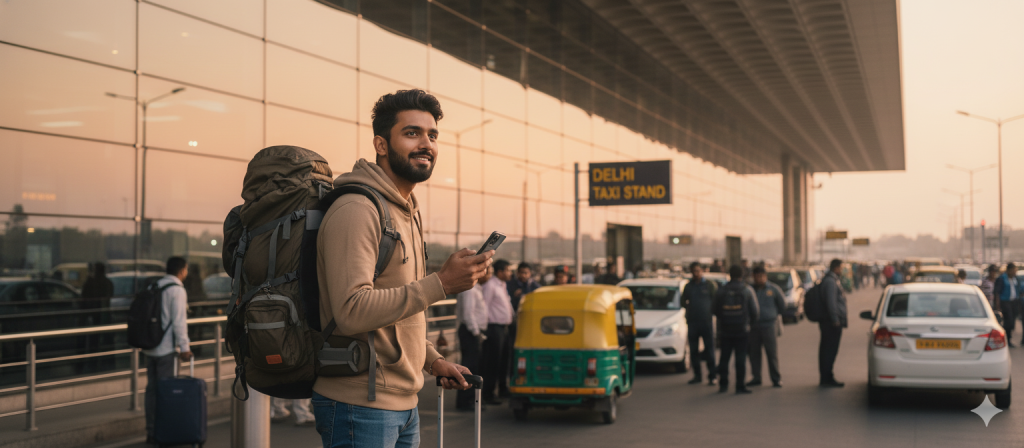
Transportation in India
In India, there are various options for getting around, via airports, buses and trains, and via domestic flights, buses, sleepers, trains, taxis, and rickshaws.
In India, there are various options for getting around - domestic flights, buses, sleepers, trains, taxis, rickshaws.
India has many and varied options for transportation that vary and are tailored to the different regions. You can travel by domestic flights from almost anywhere to anywhere, by local buses or tourist buses, trains, taxis, and of course rickshaws. India is a huge country, so traveling between different destinations often takes a good few hours and sometimes even a few days.
The different types of transportation:
– Domestic flights: The vast distances we sometimes have to cover make domestic flights particularly tempting, especially when it comes to the fact that many flights are available from almost any destination to any destination at affordable prices and can shorten a journey of several days to two hours.
For a list of all airports in India
– Train: The Indian train is an experience in itself. Some people say that you haven't really been to India until you've taken a train ride. It's a great and convenient way to get from place to place and also to meet interesting people and the local culture of the common people up close. The train cars are divided into classes of different levels.
India's national railway network covers almost the entire country (except for a few mountainous and inaccessible areas). Although the railway system may seem chaotic at first glance, most of the time it manages to serve its 1.4 billion people well. Of course, trains are often late, but they always arrive at their destination in the end.
It is worth remembering that India is vast and a train journey can often take more than 12 hours, and even several days. In such cases, it is advisable to invest and buy tickets for the more comfortable classes, there are classes with a small number of beds and with air conditioning (compared to classes where there is no air conditioning, no windows and no limit on the number of people in the carriage). It is recommended to pay attention to personal belongings and take good care of them.
Those interested in adventure and a true local experience can take the simpler classes that locals use for shorter trips.
– Buses, sleepers and semi-sleepers: Although trains are generally the most convenient and authentic way to travel in India, there are certain places (especially in the Himalayas) that trains do not reach. Buses, on the other hand, reach almost everywhere and are usually much more frequent than trains, making them an equally preferable option for getting around.
The quality of the buses varies, there are sleepers with really clean, private beds and air conditioning, semi-sleepers with folding chairs (here too there are different levels, from clean, padded seats to old, rickety semi-sleepers). Of course, there are also extremely cheap local buses where the number of people can be much larger than the number of seats.
Local buses can also provide a particularly authentic and interesting experience, and of course, much cheaper, so it is recommended to try them on trips that are not too long and exhausting.
– Jeep ride: A common method mainly in mountainous areas with rough and unpaved roads (such as from Manali to Ladakh). Sometimes traveling by jeep is the most ideal way and will offer a simpler and faster journey. However, jeep drivers sometimes travel at speeds we are not used to and do not slow down on turns and curves. It is worth preparing yourself for a shaking experience (literally). Those who are sensitive to nausea are advised to take pills with you and sit by the window, and not be shy about talking to the driver when necessary.
In large cities and tourist locations with good infrastructure, you can use convenient apps for getting around:
Uber application – UBER – An app that works great, especially in big cities, allows you to find taxi rides at very affordable prices, much cheaper than what drivers you meet on the street will try to charge. To activate the app for the first time, you need to receive a code on your phone. There is no need to enter a payment method.
Hola application – OLA – Also like Uber, a friendly and convenient app that works mainly in large cities and connects travelers with drivers, creating trips at extremely affordable prices.
Moovit – MOOVIT – An app that we know for use in Israel, but surprisingly it works great in several major cities in India. The app allows you to get directions from one destination to another within the city using public transportation, and is updated in real time with all options and modes of transportation.
12GO website – A website known throughout the East through which you can buy train or bus tickets to various destinations.








Roads in India
The first thing you’ll discover while traveling in India is that almost everything you experience – from the most amazing adventures to the most boring daily routines – is a once-in-a-lifetime experience that you won’t get to experience anywhere else. Indian culture is so different and unique that visiting it often feels like a journey to another world. So it really shouldn’t surprise us that the experience of using transportation in India is also extraordinary.
In what other country can we travel hundreds of kilometers for days on a 100-year-old train, get from place to place on camels, hop around the city on a bicycle-pulled rickshaw, and from there – use an innovative and modern metro train? India has it all when it comes to transportation solutions. Here are a few points that will help you make the most of all the options available to you and get from place to place comfortably.
Every means of transportation imaginable
Intercity transportation in India may not be the fastest or most convenient in the world, but it is very cheap and gets you pretty much anywhere. From domestic flights, to trains and buses, to boat rides or the subway – the possibilities are endless. Still, there are a few main modes of transportation that we will use most of the time.
The Indian Railway – an experience in itself
You haven’t really been to India until you’ve boarded a train. The country’s railway network covers almost the entire country, except for a few remote and mountainous areas. Although the railway system may seem chaotic at first glance, most of the time it manages to serve over 1.2 billion people well. An impressive feat by any measure. Of course, trains are often late, and sometimes very late, but they always arrive at their destination in the end.
It’s worth remembering that India is vast and a train journey can often take 12 hours or more. Therefore, in these cases, it’s worth investing in sleeper tickets that will allow you to sleep well. It’s a good idea to lock your bag and tie it to your sleeping berth to avoid any unpleasant surprises when you wake up in the morning.
For shorter trips, you can absolutely take the second class, which is used by most Indians. This is a great opportunity to chat with locals and get to know their lives up close. Indians are very keen to chat, especially on long trips, and will enthusiastically share with you (sometimes more than you would like to know) about their lives. To have a pleasant trip without coming out of it exhausted, in hot regions it is recommended to invest in AC (air-conditioned) carriages.
Domestic flights – more common than ever in India
The vast distances we sometimes have to cover make flights very tempting. Today, more than ever, flights are available at attractive prices that can shorten a journey from several days to two hours. If we are talking about long journeys, flying at the right time can be a godsend. This is especially true if we have chosen to travel with children.
Jeep ride
This is a common method in the northern regions. Traveling over rough terrain, such as from Kashmir to Himachal Pradesh, or from there to Leh, is not always available by bus. Sometimes, a jeep will simply offer a simpler and faster journey. However, it is worth preparing for a jarring experience (literally). Most jeep drivers drive like mad on narrow paths. This is the perfect time to take out the Psalms that your mother put in your bag.
Buses – the main means of transport in mountainous areas
Although trains are generally the most convenient and authentic way to travel in India, there are some places, especially in the Himalayas, that are not covered by the rail network. Buses, on the other hand, go almost everywhere and are often much more frequent than trains. In areas like Rajasthan where the railways are not developed, they will also get you from place to place much faster.
The quality of buses varies from the overcrowded and rickety government buses to the luxurious, air-conditioned private lines with padded, adjustable seats. Sometimes, it's just down to luck.
But why leave things to chance when you have a whole team that can help you plan the perfect itinerary for any destination in India? We invite you to contact the What's Up India? website and get all the information about transportation solutions in India in your area.